 |
|||||||||
 |
Home | Shop | Van Gogh's Art | Van Gogh Biography | More Artists | Contact Us | ||||||||
|
 Van Gogh's Art Collections: Van Gogh Landscapes Van Gogh Portraits Van Gogh Florals Van Gogh City and Architecture Van Gogh Best Sellers Van Gogh on Canvas Van Gogh Art - View All Van Gogh's Paintings: Allee des Alyscamps |
|
|
||||||

 |
|
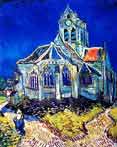
The Church at Auvers Van Gogh deliberately distorted colors, perspective, lines |
He moved to the south of France, attracted by the more intense light, which Van Gogh believed would help him see more truly and would more accurately depict his inner vision. Van Gogh developed his distinctive style in Provence, which included:
- exaggerated, intense color
- aggressive brushwork
- bold impasto paint application (thickly applied paint)
Why is Van Gogh not considered an Impressionist?
 |
|
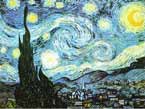
The Starry Night
Van Gogh worked with symbolism |
Most importantly, Vincent van Gogh did not consider himself an Impressionist. He saw himself as working to create the next level beyond Impressionism. The Impressionists believed firmly in several tenets which Vincent van Gogh examined, then discarded.
- Impressionists believed art was highest when it stood on its own, with no added symbolic or deeper meaning. Van Gogh's art was consciously symbolic.
- Impressionist art tried to be an objective reflection of nature. Van Gogh's art exploited nature to reflect his inner vision and emotional state: line, color, spatial composition, distortion and exaggeration were all manipulated to express his personal interior world.
- Impressionists tried to reflect the world as it was. Van Gogh's art was a communication, or expression of intellect, mystery, emotion and imagination.
Vincent Van Gogh is considered a forerunner of Expressionism. Art historians classify Van Gogh with the post-Impressionists, but this is not the name of an art movement or style. It is simply the time period and peers among whom Van Gogh created his art. Other post-Impressionists include Gauguin, Cézanne, Seurat, Toulouse-Lautrec, Matisse, Vuillard and Bonnard.
Expressionism didn't appear as an art movement until 1911 when German critics coined the term to describe the work of the Fauves and the early Cubists. Expressionist artists include Matisse, Boccioni, Kirchner, Pollock and Munch.
What were the conflicts that inspired Van Gogh's art?
 |
|
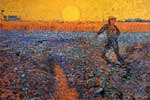
The Sower
Van Gogh celebrated common people and peasants |
Like many artists, Vincent van Gogh's art reflected several conflicts that he worked to resolve in his art:
- His desire to reflect the simplicity of the material world vs. his desire to express himself through symbols.
- His desire to live simply and humbly, like the peasants vs. his desire to live in a community of artists and to participate in the avant-garde of European culture.
- His religious beliefs and a desire to alleviate spiritual suffering vs. his practical desires to help the poor through education and social reform.
- His desire for community, family, marriage vs. a need for solitude both because of his illness and because of his need to focus on his art.
- His admiration of his Dutch heritage of painting and the Dutch masters' skill at detailed, observational painting vs. his sympathy with the French avant-garde and the desire to paint based on ideas not simple observation.
|
Contact Us Privacy |